


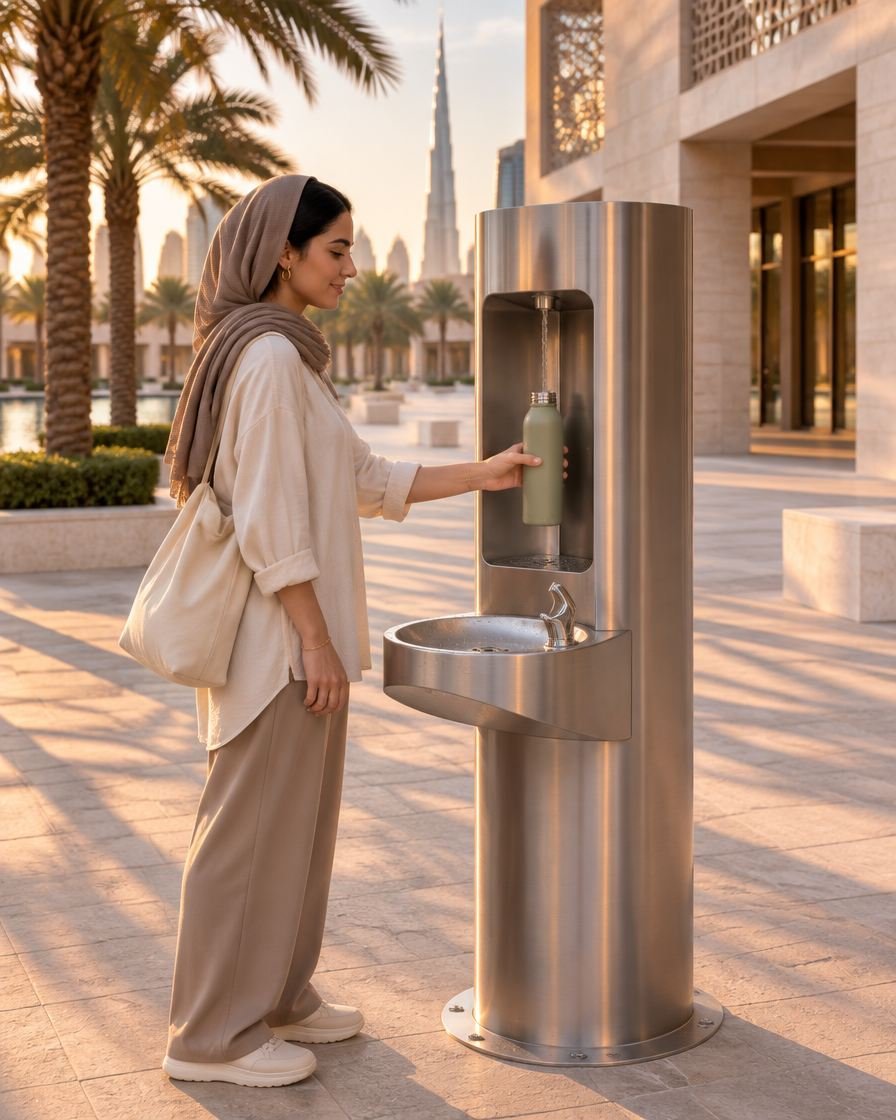
Drinking fountains, bottle fillers, or both? It's a question every hydration scope has to answer. The answer comes down to who uses the space, how they drink and what your plumbing code asks for. Here's how I'd work through it.
What each one is actually for
A drinking fountain is for a quick drink on the spot. The International Plumbing Code defines it as a fixture that lets the user "obtain a drink directly from a stream of flowing water without the use of any accessories".
A bottle filler fills a container. The same code covers that as a water dispenser, a fixture for dispensing drinking water "into a receptacle such as a cup, glass or bottle".
That difference drives everything else. A fountain serves someone walking past who wants a drink now. A filler serves someone who'll carry their water with them for the next few hours.
When a fountain fits and when a filler fits
Fountains suit short, frequent visits from people who don't carry a bottle. Think playgrounds at break time, sports pitches, park paths and the corridor outside a classroom. Nobody has to remember anything. They walk up and drink.
Bottle fillers suit people who stay put and keep water at their desk or in their bag. Offices, universities, gyms, airport gates and hospital staff areas all fit that pattern. A laminar stream fills a bottle cleanly. The Murdock BF12S, for example, delivers a laminar flow at 1.2 gallons per minute.
Most sites have both kinds of user, which is why the answer is so often both.
The case for combination units
A combination unit puts a bowl and a bottle filler on one fixture. One position on the drawing, one supply, one waste.
Indoors, the Topserw A171 BF has separate self closing buttons or sensors for the fountain and the filler, and it's designed only for indoor applications. Outdoors, the Murdock GYM74 is a stainless steel pedestal with a pushbutton fountain and a pushbutton or sensor operated filler.
If you want chilled water outside, read the installation notes. The notes for Murdock's outdoor pedestal unit with a chiller say best practice is installation beneath an overhang, avoiding direct sunlight. In a Gulf summer that's not optional detail, it belongs on the drawing.
Two more worth knowing about. For parks where people walk dogs, there's a pedestal bottle filler with a pet fountain receptor. For mental health settings, a ligature resistant fountain with bottle filler uses tapered side splashes, sloping tops and a conical bubbler to reduce ligature points.
What the code says about the mix
If your project follows the 2021 International Plumbing Code, three clauses shape the choice.
- Section 410.4. Where three or more drinking fountains are required, water dispensers can be substituted for not more than 50 percent of the required number. Bottle fillers can't replace every fountain on the count.
- Sections 410.3 and 410.3.1. Where fountains are provided on an exterior site, on a floor or within a secured area, there must be at least two: one for people who use a wheelchair and one for standing persons. A single fountain with two separate spouts that serves both can be substituted.
- Section 410.5. Drinking fountains, water coolers and water dispensers "shall not be installed in public restrooms".
If you're looking at bi level units such as the Murdock GRE24, ask for the dimensions and check them against your authority's accessibility requirements.
Check which code your authority applies, and any local amendments, before you fix the count.
Hygiene and how people use them
Start with touch. Several of the units above offer sensor operation on the filler, so nobody has to press a button to fill a bottle. Decide sensor or pushbutton per location, not per project.
Then think about maintenance. The Topserw BF15 and BF16 range offers a BCD version with a bottle counter and a filter replacement display. That gives whoever looks after the unit a visible prompt, rather than a date in a spreadsheet nobody opens.
Placement decides use. Put units where people already walk, keep them out of restrooms and keep the area around them easy to clean. A filler tucked behind a stairwell won't get used, whatever it cost.
The short version
- Fountains for quick drinks from people without a bottle.
- Bottle fillers for people who stay on site and carry water.
- Combination units where you have both, which is most sites.
- Under the 2021 IPC, dispensers replace no more than half where three or more fountains are required, and nothing goes in a public restroom. Check what your authority applies.
- Read the installation notes on chilled outdoor units. Murdock's says beneath an overhang, out of direct sunlight.
You'll find the full Hydration range on our site. Send the scope or BOQ at aquelon.com/quote and we'll come back with a priced quote within one working day.
Sources
- International Code Council, "2021 International Plumbing Code, Chapter 2 Definitions", 2021. https://codes.iccsafe.org/content/IPC2021P1/chapter-2-definitions
- International Code Council, "2021 International Plumbing Code, Chapter 4 Fixtures, Faucets and Fixture Fittings", 2021. https://codes.iccsafe.org/content/IPC2021P1/chapter-4-fixtures-faucets-and-fixture-fittings
